'Bail is free' — Police tell Nigerians to stop paying for bail, share hotline to report officers demanding cash
)
&format=webp)
Summary
The police say bail is free, and no officer is allowed to demand money before releasing a suspect in a bailable offence.
Nigerians who are asked to pay for bail have been told to report the officers by calling 080-570-00001.
The reminder comes amid longstanding public scepticism, with many Nigerians citing years of alleged police extortion and brutality despite the "Bail is Free" campaign.
For the average Nigerian, walking into a police station to secure the release of a loved one comes with an unspoken, exhausting expectation: you are going to pay.
This makes the phrase "bail is free" sound less like a legal fact and more like a joke.
From "mobilisation fees" for the Investigating Police Officer (IPO) to "administrative charges", Nigerians have been forced to pay between ₦50,000 and ₦1 million just to buy a freedom that the law already guarantees them for free.
Now, the police are once again reminding Nigerians that it isn't.
In a video circulating online, a senior police officer explains what bail really means under Nigerian law and why officers are prohibited from demanding money before releasing a suspect.
Bail is free !!
— Nigeria Stories (@NigeriaStories) June 20, 2026
Police explains what bail is and tells Nigerians it free and they should stop paying for it pic.twitter.com/QWZkr9GX2Q
What is bail?
&format=webp)
According to the officer, bail is a process that allows a suspect to leave police custody while an investigation continues.
"Bail is a process in a criminal investigation where a suspect is released to a reliable surety to produce him back whenever needed. Bail is not a punishment. Bail is not a sentence. So, the Nigerian law does not permit anyone to collect money for bail."
In simple terms, granting bail for a "bailable offence" is an administrative tool to prevent police cells from becoming overcrowded while investigations are ongoing.
READ NEXT: Edo governor pledges to sign death warrants for convicted kidnappers, pushes for public execution
It requires:
A surety – a reliable person who guarantees the suspect will return.
An IPO to process the paperwork,
And a bail bond – a legal document or written guarantee that ensures the suspect will appear in court, which costs nothing and requires no financial deposit.
It does not require a debit card, a bank transfer, or a stack of cash wrapped in brown paper.
READ NEXT: Police reject ₦500 million bribe, arrest suspect and seize Canadian Loud worth ₦7.8 billion
What to do if an officer demands money
&format=webp)
Rather than arguing with officers at the station, the police advise Nigerians to report any demand for bail money.
In the video, citizens are asked to call 080-570-00001 immediately if they are asked to pay before a suspect can be released.
The officer says the complaint line exists to help Nigerians report officers involved in illegal demands for money.
The reality: Why many Nigerians don't believe it
&format=webp)
To understand why the phrase "bail is free" is met with deep scepticism and often dark humour by Nigerians, one must look at the grim reality of law enforcement in the country.
&format=webp)


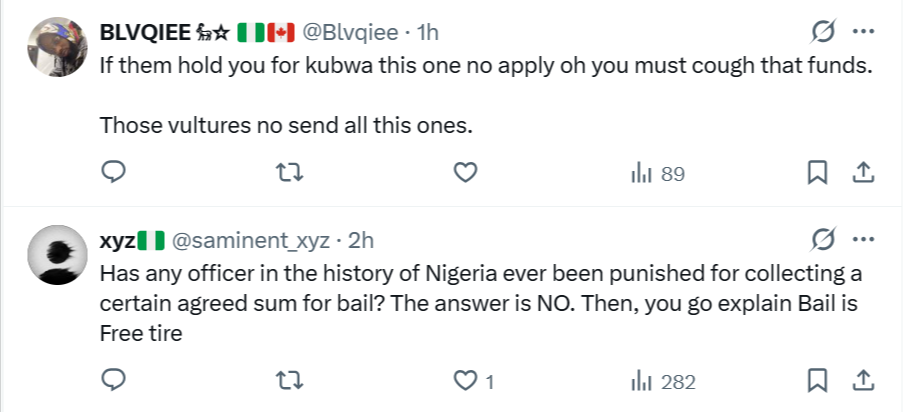
For decades, the fear of what happens inside the cell has forced families to empty their savings accounts to pay for bail.
An investigation by Amnesty International into the notorious "Tiger Base" anti-kidnapping unit in Owerri exposed a terrifying situation.
Suspects were subjected to severe torture, locked in windowless cells, and forced into writing false confessions—all used as leverage to extort millions of naira from terrified relatives under the guise of bail.
In Rivers State, human rights lawyers recently raised alarms over the Octopus Unit in Port Harcourt, where a detainee was severely beaten, slapped, and stripped of his personal belongings (each item given a "separate price tag" to be returned) before being extorted of ₦ 180,000 for his release.
In 2024, an investigation by Punch documented multiple accounts from Nigerians who said they were asked to pay for bail despite the force's insistence that it is free.
The report noted that the police have repeatedly relaunched the "Bail is Free" campaign and encouraged victims to report officers involved in extortion, but acknowledged that illegal demands persist in some stations.
That disconnect helps explain why many Nigerians react with disbelief whenever police repeat the slogan.
In all, know your rights
Under Nigerian law, administrative bail for bailable offences should not require payment.
The police say citizens should:
Know that bail is a legal right in bailable offences, not a favour.
Refuse to pay money demanded as "bail fees".
Report any officer who demands payment through the designated complaint channels instead of engaging in arguments.
&format=webp)
&format=webp)
&format=webp)
,fit(112:112)&format=webp)
&format=webp)
&format=webp)
&format=webp)